Live vs Self-Paced Online Courses
Compare live and self-paced online courses, including flexibility, interaction, feedback, accountability, learning outcomes, and which format suits different learners.
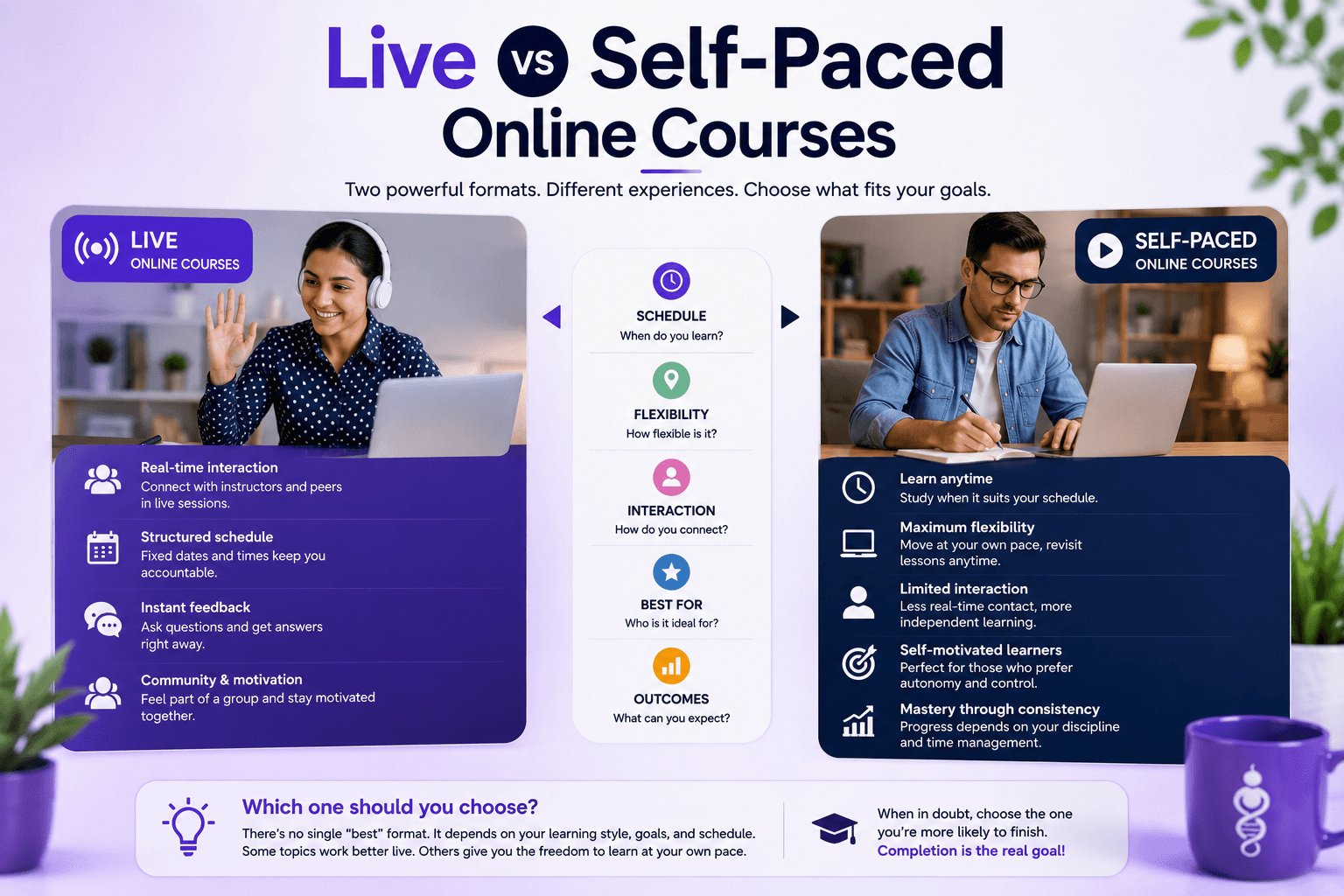
Live vs Self-Paced Online Courses: Which Is Better?
Two people can take an online course on exactly the same subject and experience completely different forms of learning.
One joins a virtual classroom every Tuesday at 7 p.m.
The instructor teaches live.
Learners ask questions.
The group discusses cases.
Assignments have weekly deadlines.
Everyone progresses through the program together.
The other learner opens the course whenever they have time.
They watch recorded explanations, complete activities, revisit difficult lessons, submit assignments, and move through the curriculum at their own pace.
Both are learning online.
But the learning experience is fundamentally different.
The first is synchronous, usually called live online learning.
The second is asynchronous, often called self-paced learning.
Neither format is automatically better.
They solve different problems.
Live learning can create immediate interaction, external structure, discussion, accountability, and faster feedback.
Self-paced learning can create flexibility, learner control, repeatability, geographic accessibility, and the ability to fit education around work and family responsibilities.
The important question is therefore not:
“Are live courses better than self-paced courses?”
It is:
“Which elements of this learning experience benefit from being synchronous, and which are better when learners control the time and pace?”
That distinction becomes particularly important in adult and professional education.
The OECD describes modern digital education as including both synchronous real-time instruction and asynchronous self-paced learning and notes that, in practice, many programs combine the two. Its quality guidance specifically recommends mixing synchronous and asynchronous interaction where appropriate to accommodate different learner needs and schedules.
The evidence comparing the two formats is also more complicated than many course-marketing claims suggest.
A 2023 meta-analysis comparing synchronous and asynchronous online learning found a slight advantage for asynchronous learning in knowledge outcomes, but the difference was trivial in size.
A newer 2025 meta-analysis of 31 randomized controlled trials involving 3,823 learners, focused on webinar-based synchronous instruction, found stronger cognitive and affective outcomes for synchronous learning compared with asynchronous programs and face-to-face conditions.
Those results appear contradictory.
They are actually useful.
They remind us that delivery mode alone does not determine learning quality.
What happens inside the live session matters.
What happens inside the self-paced course matters.
The skill being taught matters.
The learner matters.
The feedback matters.
The assessment matters.
And sometimes the strongest course uses both.
What Is a Live Online Course?
A live online course is a digital learning experience in which learners and instructors participate at the same time.
This is synchronous learning.
Examples include:
-
virtual classrooms;
-
live workshops;
-
webinars;
-
cohort classes;
-
group coaching;
-
virtual laboratories;
-
live case discussions;
-
online office hours.
Learners usually follow a schedule.
For example:
Tuesday and Thursday
18:00–20:00
Six weeks
The defining characteristic is not video conferencing itself.
It is real-time participation.
The instructor and learners can respond to one another while learning is happening.
What Is a Self-Paced Online Course?
A self-paced online course allows learners to progress without attending instruction at fixed times.
This is usually asynchronous learning.
The course may contain:
-
recorded lessons;
-
readings;
-
quizzes;
-
assignments;
-
simulations;
-
projects;
-
discussion boards;
-
downloadable resources;
-
automated feedback;
-
instructor feedback delivered later.
One learner may complete the course in two weeks.
Another may take two months.
The defining characteristic is control over timing and progression.
The learner does not need to be present at a particular hour simply to participate.
The Real Difference Is Not “Video vs Teacher”
This is an important misconception.
Live learning is sometimes described as:
Interactive teaching.
Self-paced learning is described as:
Watching prerecorded videos.
That comparison is too simplistic.
A live course can be extremely passive.
Imagine a trainer speaking for three hours on Zoom while 100 learners remain muted.
Technically:
live
Educationally:
lecture
Meanwhile, a self-paced course could contain:
-
retrieval quizzes;
-
simulations;
-
realistic cases;
-
assignments;
-
AI-supported practice;
-
projects;
-
peer review;
-
instructor feedback.
That course may require substantially more learner activity.
The better distinction is therefore not:
Live = active
and
Self-paced = passive
but:
What does the learner actually have to do in each environment?
Why Live Online Courses Can Be Powerful
Live learning has several advantages that are difficult to reproduce perfectly in asynchronous environments.
Immediate Interaction Changes the Learning Loop
Suppose an instructor teaches financial forecasting.
A learner asks:
“Why are we treating this expense as variable rather than fixed?”
The instructor can answer immediately.
The learner may respond:
“But what if the contract guarantees a minimum payment?”
Now the instructor adjusts the explanation.
Another learner joins the discussion.
A third example appears.
The learning loop becomes:
Question → explanation → clarification → deeper question
That can happen in minutes.
In a purely asynchronous course, the learner may:
-
search independently;
-
post a question;
-
wait for a response;
-
continue while confused.
Delayed feedback is not necessarily bad.
But immediate dialogue becomes especially valuable when misunderstanding depends on context.
Live Learning Is Strong for Ambiguous Problems
Some subjects contain straightforward correct answers.
For example:
What is the formula for gross margin?
Other questions require judgment.
Should this company lower its price?
Is this market attractive?
Which project risk should be prioritized?
Is this design effective?
How should this manager handle this employee conversation?
These problems benefit from discussion because learners need to explore:
-
assumptions;
-
trade-offs;
-
alternative interpretations;
-
incomplete evidence.
A good live instructor can ask:
Why?
What evidence supports that?
What would change your decision?
Does anyone disagree?
The educational value comes from exposing reasoning.
That is difficult to replicate with a prerecorded explanation alone.
Live Courses Can Create Stronger Teaching Presence
Online learners can sometimes feel as if nobody is actually teaching them.
The content exists.
The platform exists.
But the instructor feels distant.
Research on online learning describes teaching presence as involving the design, facilitation, and direct instruction that make the educator's role visible inside the learning experience.
A meta-analysis of Community of Inquiry research found that teaching presence was moderately positively correlated with actual learning, while teaching, cognitive, and social presence also showed meaningful relationships with perceived learning and satisfaction.
Live sessions make some forms of teaching presence easier.
Learners can:
-
hear the instructor respond;
-
ask follow-up questions;
-
observe demonstrations;
-
receive clarification;
-
see the instructor adapt.
But live sessions are not the only way to create teaching presence.
A strong asynchronous instructor can also create it through:
-
feedback;
-
announcements;
-
recorded responses;
-
thoughtful course design;
-
discussion facilitation;
-
office hours.
Presence is a teaching behavior.
Not merely a meeting format.
Live Courses Create External Structure
Self-paced learning asks learners to manage a great deal themselves.
Live learning reduces some of that burden.
If the session begins Tuesday at 18:00, the learner does not have to decide:
Should I study tonight?
The decision has already been partly made.
If an assignment is discussed next Tuesday, there is an external reason to complete it beforehand.
This can create accountability.
The schedule becomes part of the learning architecture:
Session
↓
practice
↓
deadline
↓
next session
For some learners, this structure is extremely valuable.
It turns:
“I'll study when I have time.”
into:
“I have class tomorrow.”
Cohorts Can Create Social Momentum
Live courses often create a cohort.
Learners begin together.
Progress together.
Encounter similar difficulties at similar times.
That creates opportunities for:
-
peer discussion;
-
collaboration;
-
comparison of approaches;
-
networking;
-
mutual accountability.
Social interaction is not automatically educational.
But when it serves a real learning purpose, it can deepen the experience.
For example:
Present your solution to the group.
Compare two approaches.
Review another team's project.
Defend your recommendation.
Now social interaction becomes part of the learning activity.
Live Teaching Can Adapt in Real Time
Imagine that an instructor planned to spend 20 minutes on a topic.
After ten minutes, it becomes obvious that almost nobody understands it.
A good live instructor can change direction.
They can:
-
slow down;
-
add an example;
-
ask diagnostic questions;
-
remove another activity;
-
demonstrate again.
The course becomes responsive.
Self-paced courses can also improve based on learner evidence.
But the adaptation usually happens between learners or cohorts rather than within the same moment.
The Limits of Live Online Learning
The strengths of synchronous learning create some of its biggest weaknesses.
The Schedule Reduces Accessibility
A session at:
Tuesday, 19:00
creates structure.
It also creates exclusion.
A learner may be:
-
working;
-
commuting;
-
caring for children;
-
living in another time zone;
-
experiencing connectivity problems.
This is particularly important in adult education.
The OECD's 2025 analysis of adult learning found that among adults who encounter barriers to participating in learning, 48% identify lack of time because of work or family responsibilities as the main barrier.
This explains part of the value of asynchronous learning.
Flexibility is not merely convenience.
For some learners, it determines whether participation is possible at all.
Live Learning Forces a Common Pace
Imagine a class of 30 learners.
Five already understand the topic.
Twenty are following comfortably.
Five are confused.
What pace should the instructor use?
Every synchronous group faces this problem.
The instructor chooses one pace for multiple learners.
Self-paced environments offer a different possibility.
One learner can replay the explanation.
Another can skip a familiar optional example.
A third can spend an hour on the exercise.
That is much harder to reproduce during one shared live session.
Live Does Not Automatically Mean Engaging
A three-hour webinar can be less engaging than a well-designed asynchronous lesson.
Synchronous teaching often fails when it becomes:
lecture
↓
lecture
↓
lecture
↓
“Any questions?”
↓
silence
Live time is expensive.
Everyone must be present simultaneously.
The instructor should therefore ask:
What are we doing live that benefits from being live?
If the answer is:
Listening to information that could have been recorded,
the session may not be using synchrony well.
Why Self-Paced Online Courses Can Be Powerful
The defining advantage of self-paced learning is flexibility.
But its educational value goes further than scheduling.
Learners Control When Learning Happens
An adult learner may study:
30 minutes before work.
One hour after dinner.
Saturday morning.
That matters because adult participation in learning is strongly constrained by time.
The OECD's 2025 Trends in Adult Learning identifies work and family responsibilities as the dominant reported barrier for adults who want more learning but cannot participate.
Self-paced learning removes one constraint:
everyone does not need to be free simultaneously.
That can dramatically expand access.
Learners Can Control Pace
A live explanation happens once.
A recording can be:
-
paused;
-
replayed;
-
slowed down;
-
revisited later.
Imagine learning Excel.
The instructor performs a formula.
You pause.
Try it.
Make a mistake.
Rewind.
Compare.
Try again.
That is a fundamentally different relationship with instruction.
The learner controls the timing of explanation around their own practice.
Self-Paced Courses Can Serve Different Prior Knowledge Levels
Suppose two people take the same project-management course.
Learner A already knows:
-
project scope;
-
timelines;
-
stakeholders.
Learner B does not.
In a live class, both usually follow approximately the same schedule.
A well-designed self-paced course can provide:
-
optional foundation modules;
-
diagnostic assessments;
-
advanced material;
-
flexible pacing.
The learning path can become more adaptable.
Self-Paced Learning Scales More Easily
An instructor can record a strong foundational explanation once.
Thousands of learners can access it.
The instructor's limited time can then be concentrated elsewhere:
-
live Q&A;
-
assignment review;
-
project feedback;
-
advanced workshops.
This becomes important for trainers.
Instead of repeatedly spending two hours delivering the same introduction, they can turn that introduction into reusable learning material.
Then human time moves toward activities where instructor judgment contributes more value.
[Internal link: Why Trainers Should Start Selling Courses Online]
But Self-Paced Learning Transfers More Responsibility to the Learner
Flexibility sounds universally positive.
It is not.
Removing the schedule also removes some external structure.
The learner now needs to decide:
When should I study?
How much should I complete?
Am I actually understanding this?
Should I continue or review?
How do I recover after missing two weeks?
This is a self-regulation problem.
Recent online-learning research has increasingly emphasized what is sometimes called learning presence: learners' ability to regulate effort, goals, strategies, and participation within digital environments. A 2026 systematic review of empirical work from 2010–2024 found that this form of learner agency is consistently associated with engagement, satisfaction, and course completion, although definitions and measurement remain an evolving area of research.
Self-paced does not mean:
Give learners complete freedom and disappear.
Good asynchronous learning provides structure inside flexibility.
Self-Paced Learners Still Need Deadlines—Sometimes
The term self-paced can be interpreted too literally.
Not every asynchronous course needs:
No deadlines. Ever.
A course can offer flexibility while still using:
-
recommended milestones;
-
target completion dates;
-
assignment windows;
-
project checkpoints;
-
reminders.
For example:
Complete Modules 1–2 during Week 1 whenever your schedule allows.
This preserves time flexibility while creating direction.
The real question is:
How much external structure does this learner need?
Delayed Feedback Can Become a Weakness
Suppose a learner attempts a complex assignment and gets stuck.
If feedback arrives one week later, momentum may disappear.
Self-paced courses therefore need deliberate feedback architecture.
Different types of feedback can happen at different speeds.
Immediate
Automated quiz explanations.
Short delay
Instructor response to a question.
Longer cycle
Detailed project review.
A strong asynchronous course anticipates:
Where is immediate feedback essential?
and:
Where can reflection before feedback actually be useful?
Isolation Can Become a Problem
Self-paced learning sometimes becomes:
Me
↓
video
↓
quiz
↓
next video
↓
certificate
There may be almost no human interaction.
For some simple learning objectives, that may be perfectly acceptable.
Not every course requires a community.
But complex professional learning may benefit from:
-
instructor feedback;
-
peers;
-
discussion;
-
mentoring;
-
office hours.
The goal is not social interaction for its own sake.
It is making human interaction available where it improves learning.
What Does Research Say About Live vs Self-Paced Learning?
The evidence does not support a simple universal winner.
A 2023 meta-analysis searched studies published between 2002 and 2022 and included 14 studies, representing 1,098 participants in synchronous conditions and 804 in asynchronous conditions.
It found that asynchronous online learning produced slightly better knowledge outcomes.
But importantly, the difference was trivial in magnitude.
If we stopped there, we might conclude:
Self-paced is slightly better.
But newer evidence complicates that conclusion.
A 2025 meta-analysis examined 31 randomized controlled trials involving 3,823 learners and focused specifically on synchronous webinar-based learning.
It found positive effects of synchronous learning on cognitive and affective outcomes compared with asynchronous and face-to-face conditions, with particularly strong effects in some comparisons involving self-efficacy.
Why do two meta-analyses point in different directions?
Possibilities include differences in:
-
included studies;
-
participant populations;
-
interventions;
-
webinar design;
-
comparison groups;
-
outcomes;
-
research methods.
That is exactly why asking:
Which format wins?
can be misleading.
The more defensible conclusion is:
Both synchronous and asynchronous online learning can be effective. Their effectiveness depends substantially on how they are designed and what learners are expected to accomplish.
The OECD's current guidance reflects this pragmatic position rather than recommending one format universally. It explicitly describes digital learning as including both synchronous and asynchronous models and recommends combining them where appropriate.
Live vs Self-Paced: The Practical Comparison
DimensionLive OnlineSelf-PacedSchedule flexibilityLowerVery highImmediate instructor interactionExcellentLimited unless supplementedLearner control of paceLimitedExcellentReal-time discussionExcellentLimitedReplay and reviewDepends on recordingsExcellentExternal accountabilityUsually strongDesign-dependentGeographic reachHigh, but time zones matterVery highFit around work/familyMore difficultStrongCohort connectionNaturally easierMust be designedIndividual pacingDifficultStrongInstructor scalabilityLowerHigherImmediate feedbackStrongDepends on designSelf-regulation demandsModerateHigherDeep discussionStrongPossible but slowerReusable instructionModerateExcellentAppropriate for large audiencesPossible, but interaction fallsStrongLearner independenceModerate–highPotentially very high
The table is useful.
But it still does not tell you which format to choose.
For that, you need to examine the learning objective.
Choose the Format Based on What Learners Must Do
Suppose you teach:
Basic Excel formulas.
Learners mainly need:
-
demonstration;
-
practice;
-
repetition.
A self-paced format may work extremely well.
Now consider:
Executive negotiation.
Learners need to:
-
respond to another person;
-
interpret language;
-
adapt;
-
practise conversations;
-
receive feedback.
Live interaction may provide much more value.
Consider:
Digital Marketing Strategy.
Some elements work beautifully asynchronously:
-
terminology;
-
frameworks;
-
examples;
-
analytics demonstrations.
Other elements might benefit from live interaction:
-
case discussion;
-
campaign critique;
-
project presentations;
-
strategic feedback.
The answer may therefore be:
both.
Live Is Particularly Useful When the Learning Depends on Interaction
Consider live components when learners need to:
-
debate;
-
negotiate;
-
role-play;
-
present;
-
ask complex questions;
-
receive immediate coaching;
-
interpret ambiguous cases;
-
collaborate under time constraints.
Subjects such as:
-
leadership;
-
coaching;
-
sales;
-
negotiation;
-
communication;
-
language conversation;
-
strategy
may contain substantial live-learning opportunities.
This does not mean the entire course must be synchronous.
It means some objectives benefit from real-time interaction.
Self-Paced Is Particularly Useful When Learners Need Flexibility and Repetition
Consider asynchronous delivery when learners need to:
-
study around work;
-
review explanations;
-
practise individually;
-
revisit difficult concepts;
-
learn foundational knowledge;
-
work through structured exercises.
Subjects involving:
-
software demonstrations;
-
technical foundations;
-
theoretical knowledge;
-
recorded worked examples;
-
individual projects
may use asynchronous instruction effectively.
Again, this does not imply zero instructor interaction.
Think About the Learner, Not Only the Subject
Two courses about the same topic might need different formats because their learners differ.
Consider:
Python Fundamentals for University Students
versus:
Python for Full-Time Finance Professionals
The professionals may need much more scheduling flexibility.
Or:
Entrepreneurship for Independent Learners
versus:
Entrepreneurship Accelerator for 20 Startup Teams
The accelerator may benefit substantially from:
-
shared deadlines;
-
peer learning;
-
mentor sessions;
-
presentations.
Course format is therefore a function of:
Skill
Learner
Context
not subject alone.
The Adult-Learner Question Changes the Decision
Adult learners frequently combine education with other responsibilities.
OECD 2023 PIAAC data show that time constraints from work and family are by far the most frequently cited barriers among adults who encounter obstacles to learning.
This makes flexibility a serious design issue.
Interestingly, fully asynchronous formats remain relatively uncommon in job-related adult learning.
Across OECD countries covered by the 2023 Survey of Adult Skills, roughly 53% of non-formal job-related learning was face-to-face, 34% online, and 14% blended. Looking at scheduling rather than delivery location, fewer than 5% of learning activities were fully asynchronous, while most occurred either in blocks or on recurring schedules.
That suggests something important.
Adults value flexibility.
But learning systems have not simply moved toward:
Everybody learns completely alone whenever they want.
Structured learning remains common.
The likely future is more nuanced:
flexible access + intentional structure.
The Strongest Model May Be “Self-Paced Foundation + Live Application”
Instead of choosing one format, ask what each format should do.
A particularly useful architecture is:
Before the live session
Learners study foundational material asynchronously.
They can:
-
watch;
-
pause;
-
practise;
-
complete a quiz.
During the live session
Do not repeat the recorded lecture.
Use time for:
-
questions;
-
cases;
-
problem solving;
-
discussion;
-
coaching.
After the live session
Learners apply the learning independently.
They:
-
complete an assignment;
-
build part of a project;
-
reflect.
Next live session
Review common problems.
The structure becomes:
Learn → practise → discuss → apply → feedback
Now each format has a distinct job.
Do Not Waste Live Time Delivering Information Learners Could Study Independently
Imagine a two-hour live class.
The instructor spends:
105 minutes presenting slides.
15 minutes answering questions.
An alternative might be:
Before class
45-minute asynchronous lesson.
Live
15-minute clarification.
30-minute case.
30-minute group exercise.
30-minute discussion.
15-minute project feedback.
Same subject.
Different use of synchronous time.
Live time becomes valuable precisely because it is scarce.
Do not use it for something asynchronous learning handles better unless there is a specific instructional reason.
Do Not Make Self-Paced Learning Mean “Learn Alone”
The opposite mistake also occurs.
The trainer creates recorded lessons and concludes:
The course is self-paced, so I do not need to interact.
Self-paced describes the timing of learning.
It does not require the absence of teaching.
A self-paced course can include:
-
asynchronous instructor feedback;
-
scheduled optional office hours;
-
learner discussion;
-
periodic Q&A;
-
project review.
The learner controls when they consume core instruction.
Human support can still exist around it.
Assessment Should Influence the Choice
Ask:
How will learners demonstrate the skill?
If the assessment is:
Multiple-choice knowledge test,
either format may work.
If it is:
Conduct a live sales conversation,
you need interaction somewhere.
If it is:
Build a financial model,
self-paced project work may be ideal.
If it is:
Defend an investment recommendation against questions,
a live presentation might add useful evidence.
The learning format should support the assessment.
And the assessment should support the learning outcome.
[Internal link: How Quizzes and Assignments Improve Learning]
Feedback Should Influence the Choice Too
Consider how much expert feedback learners require.
Some skills can use immediate automated feedback.
For example:
Correct formula: B.
Other learning depends on professional judgment.
Your marketing strategy is coherent, but your positioning is too broad.
That feedback can be delivered asynchronously.
But sometimes dialogue adds value.
Learner:
Why is it too broad?
Instructor:
Because you're trying to differentiate around three different benefits. Which one matters most to this customer?
Learner:
Probably speed.
Instructor:
Then rebuild the positioning around that assumption.
That is where live feedback can become powerful.
What About Completion and Accountability?
Live courses often feel more accountable because:
-
sessions are scheduled;
-
other learners are present;
-
deadlines are visible;
-
instructors notice absence.
Self-paced courses must build accountability more deliberately.
Useful mechanisms include:
-
milestone dates;
-
progress tracking;
-
reminders;
-
project checkpoints;
-
recommended study plans;
-
instructor outreach.
But there is another point.
A learner completing a live course does not necessarily mean they mastered the subject.
They may attend every session and remain passive.
Likewise, a self-paced learner may take longer but complete demanding projects successfully.
Accountability should ultimately be connected to:
learning activity
rather than simply:
attendance.
What About Course Length?
Self-paced learning can make long programs easier to fit around schedules.
But excessive flexibility can allow the course to stretch indefinitely.
A six-week course becomes six months.
Then a year.
Trainers can address this through:
recommended pace
rather than necessarily:
mandatory pace.
For example:
Recommended: one module per week.
Expected effort: 3–4 hours weekly.
Complete within three months for the strongest continuity.
Now learners have guidance while retaining flexibility.
What About Community?
Live cohorts naturally create shared moments.
Everyone experiences:
the difficult case from Week 3.
the presentation from Week 5.
the final showcase.
This can create social cohesion.
Self-paced communities have a different challenge.
One learner may be in Module 2 while another is finishing Module 8.
Discussion must therefore be organized around:
-
topics;
-
questions;
-
projects;
rather than shared weekly chronology.
Neither is inherently better.
They create different social structures.
A Better Decision Framework
Instead of asking whether live or self-paced learning is universally superior, evaluate five questions.
1. How important is scheduling flexibility?
If learners are working professionals across different time zones, self-paced learning becomes attractive.
2. How much real-time interaction does the skill require?
If immediate conversation, role-play, coaching, or collaborative decision-making is essential, use live components.
3. How much pacing control do learners need?
If learners enter with widely different prior knowledge, asynchronous materials provide flexibility.
4. How much external accountability do learners need?
If learners benefit substantially from schedules, cohorts, and regular deadlines, live or cohort-based structures may help.
5. Can the course combine both?
Often the answer should be yes.
A Practical Example
Suppose a trainer wants to teach:
How to Build a Digital Marketing Strategy
Fully Live Model
Week 1: Customer research
Week 2: Positioning
Week 3: Channels
Week 4: Content
Week 5: Budget and metrics
Week 6: Presentations
Strengths: interaction, accountability, discussion.
Weaknesses: schedule dependence, limited replay, shared pace.
Fully Self-Paced Model
Recorded modules.
Quizzes.
Templates.
Assignments.
Final project.
Strengths: flexibility, replay, scalability.
Weaknesses: requires stronger self-regulation and deliberate feedback architecture.
Combined Model
Self-paced foundation lessons.
Weekly project milestone.
Optional live Q&A.
Two compulsory case workshops.
Asynchronous assignments.
Final live strategy presentation.
Now:
Information becomes asynchronous.
Practice happens throughout.
Complex interaction becomes synchronous.
This may use each format closer to its strengths.
The Bigger Lesson: Format Should Follow Learning
Course creators sometimes choose the format first.
“I want to create a live cohort.”
Then they design learning around it.
Or:
“I want passive income, so everything must be prerecorded.”
Then educational decisions are made around the business model.
Those considerations matter.
But a stronger design process begins with:
What should learners become capable of doing?
Then:
What learning activities will help develop that capability?
Then:
Which activities need real-time interaction?
Then:
Which should learners control independently?
Only then choose the delivery architecture.
[Internal link: How to Structure an Online Course Curriculum]
What Learners Should Ask Before Choosing
If you are deciding between two courses, do not ask only:
Which one is live?
Ask:
How do I learn best when nobody sets my schedule?
If you repeatedly buy self-paced courses and never finish them, that is useful evidence.
Ask:
Do I need direct access to the instructor?
Ask:
Will I receive feedback?
Ask:
Can I replay important material?
Ask:
What happens if I miss a live session?
Ask:
How much of the course requires discussion?
Ask:
What do I actually need to produce?
The right format is partly about the course.
It is also about knowing yourself as a learner.
[Internal link: How to Choose the Right Online Course]
What Trainers Should Ask Before Choosing
For trainers, the decision should not be:
Which model is easier for me?
Ask:
Where does my presence genuinely improve learning?
Perhaps learners do not need you to explain the definition of market segmentation live for the fifteenth time.
They may need you when they try to decide:
Which segment should this company actually target?
This creates an important principle for scalable teaching:
Record what can be repeated.
Be present where judgment, interaction, and feedback create value.
That can produce a much stronger learning system than either:
everything live
or:
everything automated.
Where GenAlpha Fits
A platform can make this distinction easier to design.
A trainer can use online course infrastructure for:
-
lessons;
-
quizzes;
-
assignments;
-
independent projects;
-
learner progress.
Then combine those elements with live sessions where synchronous interaction adds value.
The course architecture might become:
Self-paced lesson
↓
quiz
↓
assignment
↓
live case session
↓
project
↓
feedback
This creates a learning experience rather than forcing every teaching activity into one delivery format.
[Internal link: How GenAlpha Helps Trainers Build Better Courses]
Frequently Asked Questions
Are live online courses better than self-paced courses?
Not universally. Research comparing synchronous and asynchronous online learning produces mixed results, including a 2023 meta-analysis that found a trivial advantage for asynchronous learning on knowledge outcomes and a newer 2025 meta-analysis of webinar-based learning that reported stronger cognitive and affective outcomes for synchronous instruction. Differences in course design, learners, outcomes, and study methods matter.
What is the difference between live and self-paced online learning?
Live online learning is synchronous: learners and instructors participate at the same time. Self-paced learning is asynchronous: learners can engage with instructional material and activities at different times and usually have greater control over their progression.
Who should choose a self-paced course?
Self-paced courses can work especially well for learners who need schedule flexibility, have strong self-regulation, want to revisit material, or need to combine learning with work and family obligations.
Who should choose a live online course?
Live courses can be particularly useful for learners who benefit from external structure, immediate instructor interaction, cohort accountability, discussion, role-play, or real-time feedback.
Are self-paced courses harder to finish?
They can place greater demands on self-regulation because learners need to manage their own time, goals, progress, and study strategies. This does not mean self-paced courses inherently produce lower completion; strong course design can provide milestones, reminders, feedback, and support.
Do self-paced courses have instructors?
They can. Self-paced refers primarily to timing. A course can still include instructor feedback, asynchronous questions, optional office hours, project review, or periodic live sessions.
What is the best format for working professionals?
Often a flexible asynchronous foundation works well because time constraints from work and family are major barriers to adult learning. However, live sessions may still add value for coaching, discussion, project feedback, or practice.
Can a course be both live and self-paced?
Yes, and many effective programs combine the two. OECD guidance explicitly notes that modern digital programs frequently integrate synchronous and asynchronous delivery rather than treating them as mutually exclusive formats.
Conclusion
The debate between live and self-paced online learning is often framed as though one format needs to defeat the other.
That is the wrong question.
Live learning provides things that asynchronous learning cannot perfectly reproduce:
real-time conversation
immediate adaptation
shared experience
external structure
synchronous practice
Self-paced learning provides things live instruction cannot easily reproduce:
schedule flexibility
individual pacing
replay
scalability
learner control
Each solves a different constraint.
Each also creates different risks.
Live learning can become scheduled passive lecture.
Self-paced learning can become flexible isolation.
A poorly designed course does not become good because it is live.
A well-designed course does not become weak because it is asynchronous.
The strongest question is therefore:
What should happen when learners are together, and what should happen when learners are in control of their own time?
Sometimes the answer is entirely live.
Sometimes entirely self-paced.
Increasingly, the strongest answer may be:
Teach foundational knowledge asynchronously.
Let learners practise at their own pace.
Use live time for interaction, judgment, coaching, and feedback.
Then the format stops being the learning strategy.
It becomes what it should have been all along:
a tool chosen to serve the learning.
External Sources Used
OECD — Quality Matters: Strengthening the Quality Assurance of Adult Education and Training
Published: December 5, 2024
Used for definitions of synchronous and asynchronous digital learning, adult-learning flexibility, active learning, quality considerations, and the recommendation that digital programs combine synchronous and asynchronous interactions where appropriate.
OECD — Quality Matters
OECD — Trends in Adult Learning
Published: 2025
Used for current adult-learning participation, scheduling patterns, delivery modes, and the importance of time flexibility. OECD PIAAC data show that 53% of non-formal job-related learning was face-to-face, 34% online, and 14% blended across participating economies, while fully asynchronous scheduling accounted for less than 5% of activities.
OECD — Trends in Adult Learning
OECD — Why Is Participation Not More Common?
Used for adult-learning barriers. Among adults reporting obstacles to participation, 48% identified insufficient time because of work or family responsibilities as the primary barrier.
OECD — Adult Learning Barriers
Zeng & Luo — Interactive Learning Environments
Study: Effectiveness of Synchronous and Asynchronous Online Learning: A Meta-analysis
Published online: 2023
Used for the direct comparison of synchronous and asynchronous online learning. The meta-analysis included 14 studies, with 1,098 synchronous and 804 asynchronous participants, and found an advantage for asynchronous learning on knowledge outcomes that was trivial in size.
View the synchronous vs asynchronous meta-analysis
Webinar-Based Synchronous Learning Meta-analysis — Educational Research Review
Published: 2025
Used as recent counterevidence to simplistic claims that asynchronous learning is always superior. The meta-analysis examined 31 randomized controlled trials involving 3,823 learners and reported stronger cognitive and affective outcomes for synchronous webinar-based learning across several comparisons.
Martin, Wu, Wan & Xie — Online Learning
Study: A Meta-Analysis on the Community of Inquiry Presences and Learning Outcomes in Online and Blended Learning Environments
Published: 2022
Used for evidence concerning teaching, social, and cognitive presence in online and blended environments. The meta-analysis included 19 empirical studies and found meaningful associations between these presences and actual learning, perceived learning, and satisfaction.
Read the Community of Inquiry meta-analysis
The Internet and Higher Education — Learning Presence in the Revised Community of Inquiry Framework
Published: January 2026
Systematic review of empirical research from 2010–2024 used for the discussion of learner agency and self-regulation in online environments. The review found learning presence consistently associated with engagement, satisfaction, and course completion, while noting continuing conceptual and measurement differences across studies.